
Category: esop
-
M&A Fundamentals for Employee-Owned Companies
The Largest Ownership Transfer in Our History Is Already Underway Every week I talk with ESOP CEOs who tell me the same thing. Their phone is ringing more often. A banker has a deal. A competitor’s founder is thinking about retirement. A supplier in the next state over wants to know if they would be…
-

The Rise of Buyer-Led M&A: Why ESOPs Are Built to Win It
If you run a profitable, well-established business, your email inbox probably tells you something. Mixed in among the customer notes, vendor messages, and internal updates is a steady stream of unsolicited outreach from people you have never met, all making some version of the same pitch: they represent serious capital, they are interested in acquiring…
-
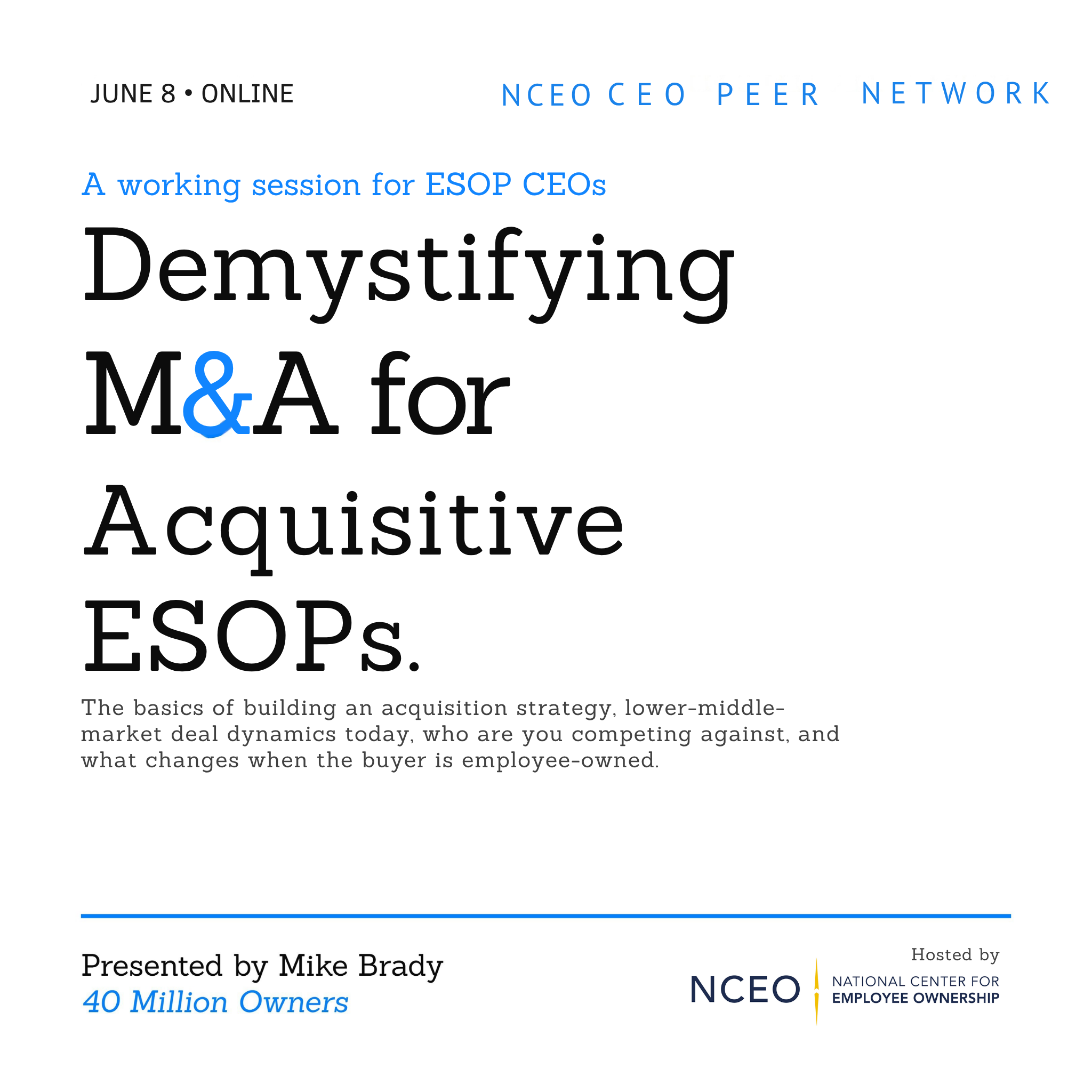
CEO Peer Network Working Session
Most ESOP CEOs are closer to their first acquisition than they think. They just do not know where to start, and many do not have a peer group that has been through it. On June 8, Mike Brady, CEO and Co-founder of 40 Million Owners, will be leading an NCEO CEO Peer Network session designed…
-
Building the Future of Employee Ownership Through Acquisition
Most people still think of employee ownership as a succession strategy. We do not. At 40 Million Owners, we believe employee ownership is one of the most underutilized growth strategies in the American economy. Over the next twenty years, millions of business owners will retire, transferring trillions of dollars in enterprise value. Many of these…
-
How ESOPs Source Deals Worth Closing: Three Channels, Purpose-Built
Most ESOP companies that get serious about growth through acquisition face the same early problem. The strategic rationale is sound, the board is aligned, and leadership has a general sense of what they want to buy. Then the question nobody has a clean answer to surfaces: where do the deals actually come from? The supply…
-

Six Steps to Prepare ESOPs for Strategic Acquisitions
An acquisition framework gives the organization a shared foundation for decision-making. It aligns management, the board, and the ESOP trustee around a clear strategic intent, disciplined criteria, and defined roles.