
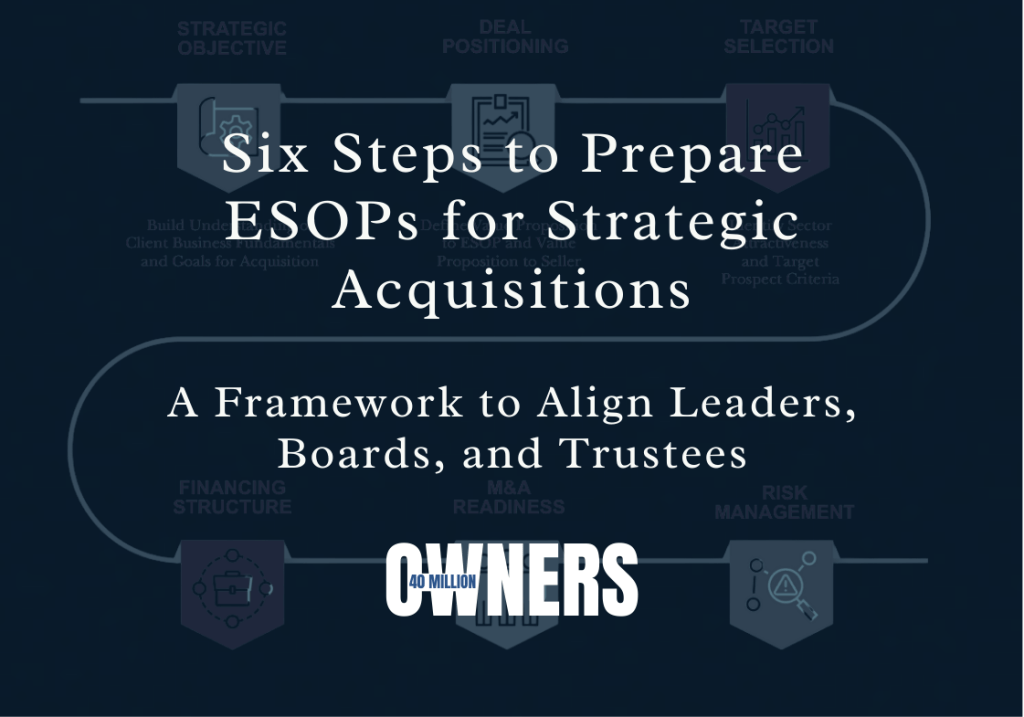
A Framework to Align Leaders, Boards, and Trustees
Getting started with an acquisition is difficult. Even strong management teams with healthy businesses often hesitate at the starting line. There are too many unanswered questions and too much at stake. Why pursue acquisitions at all? What kind of company should we buy? How much risk is acceptable? Who is responsible for what decisions? What happens if an opportunity appears before we feel ready?
For employee-owned companies, these questions carry added weight. An acquisition is not simply a growth initiative or a financial transaction. It is a long-term commitment made on behalf of employee-owners whose retirement security, livelihoods, and sense of ownership are directly affected by the outcome. That is why building an acquisition framework before pursuing a deal is so valuable.
An acquisition framework gives the organization a shared foundation for decision-making. It aligns management, the board, and the ESOP trustee around a clear strategic intent, disciplined criteria, and defined roles. Instead of reacting under stress when an opportunity arises, leadership can respond thoughtfully, with confidence and consistency. The framework does not commit the company to buy anything. It simply ensures that when the time comes, decisions are grounded in purpose rather than urgency.
At its core, disciplined acquisition planning is about responsibility. ESOPs that approach growth with discipline tend to outperform over time because they are clear about what they are trying to build and what they are willing to risk to get there. That clarity creates compounding value for employee-owners while strengthening the company’s competitive position.

1. Strategic Objective, Start with Why
The first step in preparing for acquisitions is establishing a clear strategic objective. Leadership must build a shared understanding of the company’s business fundamentals and the role acquisitions are meant to play in its long-term strategy. This conversation goes well beyond growth for growth’s sake. It forces clarity around whether acquisitions are intended to deepen core capabilities, expand geographically, diversify revenue, add talent, or strengthen resilience.
This step cannot live solely with management. Boards and trustees must be part of the discussion because acquisitions affect enterprise risk, valuation, and long-term repurchase obligations. When the strategic objective is explicit, future decisions become easier. When it is vague or assumed, every potential deal becomes a debate.
2. Deal Positioning, Define the Value Proposition
Once the strategic objective is clear, the organization can define its deal positioning. Employee-owned companies often underestimate how attractive they can be as buyers. Many sellers care deeply about legacy, stewardship, and the future of their employees. ESOP-owned buyers can offer something different from traditional financial buyers, but only if that value proposition is clearly articulated.
Internally, deal positioning clarifies how acquisitions support the ESOP’s long-term health, including sustainable cash flow, leadership continuity, and cultural alignment. Externally, it helps sellers understand why this company is the right home for their business. A clear value proposition prevents the organization from chasing transactions that look interesting financially but do not align with who it is or how it creates value.
3. Target Selection, Be Deliberate About Where to Play
With an objective and positioning established, leadership can turn to target selection. Disciplined target selection starts at the sector level, not with individual companies. Clearly identifying industries that align with employee ownership, while avoiding those that introduce unnecessary risk or complexity, helps leadership focus resources where they are most likely to create durable value. Sector analysis helps narrow the playing field before time and resources are spent evaluating specific opportunities.
At the company level, clear criteria matter just as much. Size, geography, customer mix, leadership transition needs, and cultural fit all influence whether an acquisition is likely to succeed. Using structured scorecards to evaluate sectors and targets creates consistency and transparency. It ensures that every opportunity is measured against the same standard and reduces the risk of decisions driven by momentum or fear of missing out.
4. Financing Structure, Model Before You Commit
Financing structure is the next critical step. For ESOPs, how a deal is financed is often as important as what is being acquired. Leadership needs to understand leverage tolerance, cash flow resilience, and the impact of different scenarios on future repurchase obligations. This work should be done well before a specific deal is under consideration.
Baseline financial models and scenario analyses allow the company to test different acquisition sizes and structures in a low-pressure environment. Instead of scrambling to determine affordability in the middle of negotiations, leadership already knows its boundaries. That preparation leads to better decisions and stronger negotiating positions.
5. M&A Readiness, Assess Organizational Capacity
Even the best strategy and structure will fall short if the organization is not ready to execute. Assessing M&A readiness requires an honest look at internal capacity. Who leads the deal process? Who owns diligence, communication, and integration? Does management have the bandwidth to pursue an acquisition while running the core business?
This step often surfaces gaps that can be addressed in advance. Clarifying roles, establishing a deal team structure, and defining decision rights reduces confusion and strain when execution begins. Readiness is not about building a large internal M&A team. It is about knowing where internal leadership is essential and where external support is required.
6. Risk Management and Integration, Plan for Day One and Beyond
Finally, disciplined preparation requires early attention to risk management and integration. Risk does not begin at closing. It begins the moment a company starts pursuing acquisitions. Leadership must identify the risks that matter most, both financial and cultural, and think through how integration will be approached at a high level.
For employee-owned companies, integration planning is inseparable from ownership culture. How new employees are welcomed, how leadership transitions are handled, and how communication reinforces trust all shape whether value is created or eroded after closing. Thoughtful preparation does not eliminate risk, but it dramatically improves the organization’s ability to manage it.
Meeting the Fiduciary Obligation to Be Prepared
For CEOs, boards, and trustees of employee-owned companies, documenting an acquisition framework is not a commitment to transact. It is a fiduciary responsibility to understand whether and how inorganic growth could support long-term value for employee-owners.
The six steps outlined above provide a disciplined way to meet that obligation. Together, they ensure leadership has clarity on strategic intent, deal positioning, target selection, financing capacity, organizational readiness, and integration risk before an acquisition opportunity is ever on the table. This preparation allows governance and management to evaluate acquisitions through a shared, well-understood framework rather than under compressed timelines or external pressure.
A documented framework creates optionality. It enables CEOs to prepare the organization thoughtfully, while allowing boards and trustees to exercise informed oversight and risk management. It also makes it easier to say no when opportunities fall outside agreed criteria or threaten the long-term health of the ESOP.
For employee-owned companies, inorganic growth should be intentional, not reactive. By working through these six preparatory steps in advance, leaders and fiduciaries fulfill their duty to employee-owners, preserving flexibility around when and why to pursue acquisitions while protecting long-term value.
About 40 Million Owners
40 Million Owners is an employee-owned firm focused exclusively on helping other ESOPs grow through strategic acquisitions. We equip ESOP CEOs, boards, and trustees with the strategy, resources, and hands-on support needed to pursue growth while continuing to operate their core business. As an ESOP ourselves, we understand the unique fiduciary, cultural, and operational challenges employee-owned companies face when considering acquisitions. To help leaders get started, we have created a practical guide, Demystifying M&A for Acquisitive ESOPs, designed specifically for ESOP decision-makers.
 40 MILLION OWNERS
Leave a comment