By transitioning businesses into employee-owned social enterprises, we create earned income models that seamlessly align with your nonprofit’s mission. These strategies deliver value for everyone—suppliers, employees, investors, customers, community leaders, and policymakers—uniting capital and purpose for the greater good.
We connect nonprofit leaders with business owners to transform businesses into sustainable social enterprises.
Benefits to Your Nonprofit
Revenue Diversification
Generate earned income to support your operations while reducing reliance on traditional fundraising.
- Long-term earned income models
- Advantageous tax structures
- New platform for fundraising
Program Delivery Platform
Use the business as a hub for providing job training, employment, or community development aligned with your mission
- Apprenticeship models
- Local social service employee support
- Childcare and housing subsidies
Community Impact
Expand your nonprofit’s reach while empowering workers through ownership
- Long-term income
- Job training and workforce development
- Worker wellbeing programs
- Reduced recidivism
Why now?
Over the next decade, 2.3 million small businesses, representing $10 trillion in assets and 25 million jobs, are expected to change hands as their Baby Boomer owners retire. This massive transition signals a significant economic shift, with far-reaching implications for employment, wealth distribution, and market dynamics. This phenomenon is known as the “Silver Tsunami.”
Social enterprise strategies that enhance value for all stakeholders – suppliers, owners, employees, investors, customers, community leaders, and lawmakers – align capital for the greater good.
A Social Enterprise in Action
Mike Brady, co-founder of 40 Million Owners and former CEO of Greyston Foundation and Greyston Bakery, turned the organization into an iconic social enterprise by integrating a for-profit commercial bakery with a mission-driven nonprofit foundation. Renowned as the supplier of brownies for Ben & Jerry’s ice cream, Greyston Bakery became a trailblazer for businesses seeking to combine meaningful social impact with commercial success.
How We Work with Nonprofits
Establish the Social Enterprise Framework
Conduct a Feasibility Assessment: Evaluate your nonprofit for readiness for a social enterprise strategy by analyzing financial health, organizational culture, and long-term goals.
Engage Stakeholders: Educate board members, management, and program managers about the benefits and responsibilities of a social enterprise model to ensure alignment and buy-in.
Define Social Objectives: Identify clear social impact goals that align with the nonprofit’s mission and community needs, such as fair wages, inclusive hiring, or environmental sustainability.
Determine Funding Model: Create capital campaign or alternate funding strategy to execute on social enterprise strategy.
Identify Optimal Structure and Plan
Develop Impact Metrics: Establish measurable outcomes to track progress on objectives, creating accountability and transparency.
Identify Business Owners: Identify local or regional business owners open to employee ownership transitions and passionate about the mission of the nonprofit.
Use Community Partnerships for Pipeline: Collaborate with local organizations, funders, and business to build pipeline and amplify the nonprofit’s strategy.
Choose the Right Ownership Model: Select an appropriate structure such as an ESOP, worker cooperative, or Employee Ownership Trust (EOT) based on the company’s unique needs and values.
Execute the Ownership Transition
Secure Financing: Identify and secure funding sources for the employee ownership transaction, including seller financing, external loans, or internal contributions.
Empower Employee Owners: Provide training and leadership development to enable employees to take an active role in decision-making and drive the company’s mission forward in alignment with nonprofit.
Promote the Model: Share the company’s journey and success as an employee-owned social enterprise to inspire others and strengthen the broader movement for purpose-driven business.
The Case for Employee Ownership
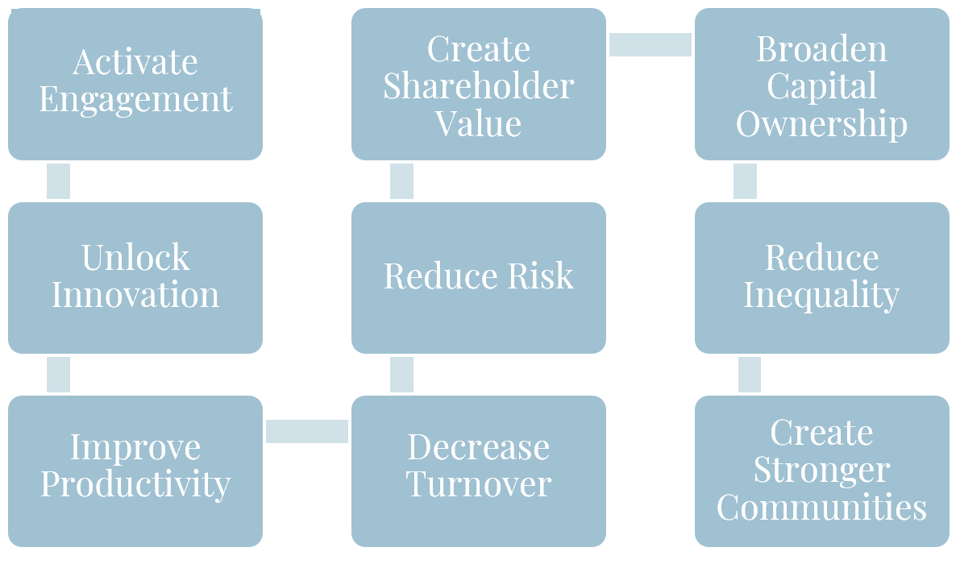
 40 MILLION OWNERS